
"coffee bean countries"
40000 article(s) found

A brief introduction to the slightly spicy Paradise Bird Manor boutique Coffee Bean Flavor, taste and aroma
Papua New Guinea's top coffee beans (PNG AA) are as beautiful and precious as the country's national bird of paradise. As coffee is widely grown in highlands between 1300 and 1800 meters above sea level, it is usually full-grained and varied in taste, with pleasant acidity and fruit-like sweetness. PNG coffee beans are carefully washed Arabica beans, its texture

Beautiful sweetness of El Salvador Himalayan boutique coffee beans cultivation geographical location climate sea
El Salvador's coffee accounts for 40% of the country's exports, and it is usually picked in November, December and the 13th of the following year. The export of raw beans lasts almost all year round. Coffee is produced in seven of the country's 14 provinces, with the largest number in the northwestern provinces of chalatenango and santa ana. The coffee produced in El Salvador is 100% Arabica, of which 68% is

Beautiful sweetness of El Salvador Himalayan boutique coffee bean flavor, taste and aroma description, Jane
El Salvador's coffee accounts for 40% of the country's exports, and it is usually picked in November, December and the 13th of the following year. The export of raw beans lasts almost all year round. Coffee is produced in seven of the country's 14 provinces, with the largest number in the northwestern provinces of chalatenango and santa ana. The coffee produced in El Salvador is 100% Arabica, of which 68% is

How are raw coffee beans graded? the grading method of raw coffee beans in various countries
For the exchange of professional baristas, please pay attention to the rating methods of raw coffee beans in the coffee workshop (Wechat official account cafe_style). There are three main rating criteria for raw coffee beans, and different countries adopt different rating methods according to their own production conditions and national conditions (not all coffee producing countries adopt the same method). One: the reason for this is classified according to the altitude of the coffee producing area.

The cultivation of El Salvador Himalayan boutique coffee beans with excellent balance geographical location and climate sea
El Salvador's coffee accounts for 40% of the country's exports, and it is usually picked in November, December and the 13th of the following year. The export of raw beans lasts almost all year round. Coffee is produced in seven of the country's 14 provinces, with the largest number in the northwestern provinces of chalatenango and santa ana. The coffee produced in El Salvador is 100% Arabica, of which 68% is

What are the categories of coffee beans? which countries produce coffee?
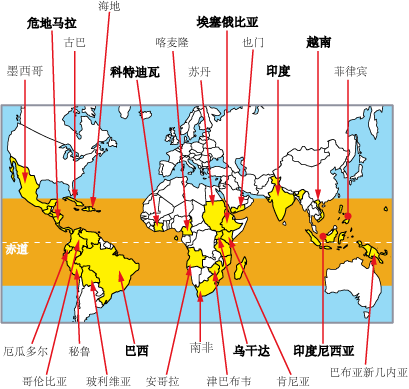
Countries that produce coffee beans Brazil is the largest exporter of coffee beans in the world, followed by Colombia. These two Central and South American countries account for more than half of the world's coffee production, and the quality is stable. Vietnam has developed rapidly in recent years and has become the second largest coffee exporter in the world. Other countries and producing areas, such as Indonesia, Ethiopia, Guatemala

A brief introduction to the treatment method of grinding degree and baking degree of fine coffee beans in moderate acidity Paradise Bird Manor
Papua New Guinea's top coffee beans (PNG AA) are as beautiful and precious as the country's national bird of paradise. As coffee is widely grown in highlands between 1300 and 1800 meters above sea level, it is usually full-grained and varied in taste, with pleasant acidity and fruit-like sweetness. PNG coffee beans are carefully washed Arabica beans, its texture

The treatment method of grinding degree and baking degree of El Salvador Himalayan boutique coffee beans with excellent balance
El Salvador's coffee accounts for 40% of the country's exports, and it is usually picked in November, December and the 13th of the following year. The export of raw beans lasts almost all year round. Coffee is produced in seven of the country's 14 provinces, with the largest number in the northwestern provinces of chalatenango and santa ana. The coffee produced in El Salvador is 100% Arabica, of which 68% is

African Coffee producing countries introduce Robart Coffee Bean, Uganda Coffee producing country
The equator runs across Uganda, and the suitable climate makes it the main producing area of Robart coffee beans in the world. In the 1960s, Ugandan coffee production remained at 3.5 million bags a year. By the mid-1980s, coffee production had dropped to 250 bags a year, mainly for political reasons. But now coffee production is on the rise again, currently about 3 million bags a year. What the coffee industry is facing

Coffee producing countries in the world introduce coffee bean producing countries in Africa
African producing countries 1. Ethiopia Ethiopia Ethiopian coffee is neither strong nor irritating. It is produced in Harald (Harrar), Yega Xuefei (Yirgacheffe), Sidamo (Sidamo), Limu (Limu), Djimmah (Djimmah), Lekempti (Kepa), Kapa and other places. Among them, Harald coffee is the substitute of Ethiopian coffee.

Fine coffee Rwanda coffee raw bean rules Rwanda coffee bean producing area
High-quality coffee comes from washed Arabica beans, which has a unique and perfect flavor. Rwanda coffee is absolutely high quality in the form of washed Arabica beans. As far as Africa is concerned, its coffee industry attracts attention because the country thrives mainly by producing the best possible coffee beans. The taste of Rwandan coffee is described as "grass aroma", with

A brief introduction to the description of the flavor and aroma characteristics of coffee beans in the clean and smooth Paradise Bird Manor
PNG coffee beans have a rich flavor, pleasant aroma, no herbal or earthy flavor, coupled with the rarity of things, in recent years, the top coffee beans in Papua New Guinea (Papua New Guinea) are as beautiful and precious as the country's national bird of paradise. As coffee is widely grown in highlands between 1300 and 1800 meters above sea level, it is usually grown in grains.
The History and Culture of Coffee beans Coffee changes the World
United States: giving up hundreds of millions of inheritance rights for coffee beans in the 1970s and 1980s, the rulers and generals of Guatemala and El Salvador had huge coffee fields, devouring most of their profits, while farmers had no meals. Many farmers, especially Indians, joined the Communist guerrillas and attacked government forces, and the authorities responded with the Holocaust, aggravating the deep feud between coffee farmers and the government.

Characteristics of Costa Rican coffee beans Costa Rican coffee bean flavor
Tarrazu in Costa Rica is one of the major coffee producing areas in the world. The coffee produced is light and pure in flavor and pleasant in aroma. Costa Rica, with its fertile volcanic soil and good drainage, is the first country in Central America to grow coffee and bananas for commercial value. Coffee and bananas are the country's main exports. In 1729, coffee was introduced from Cuba to Goth.

A brief introduction to the Market Price of Fine Coffee Bean varieties in Paradise Bird Manor
The coffee industry plays an important role in the country's economy. More than 1 million people are directly and indirectly engaged in the industry. The government encourages planting by offering a minimum purchase price. The industry itself is controlled by the Coffee Industry Council (Coffee Industry Board). The commission is located in Goroka, in the eastern part of the island, while exports are handled by private companies. The frost of 1975

Fruit-flavored Costa Rican fine coffee beans grind degree roast degree processing method brief introduction
Costa Rican Coffee Tarasu is located south of the country's capital San Jos and is one of the country's most prized coffee plantations. La Minita Tarrazu coffee is locally famous but produced in limited quantities, about 72600 kilograms per year, grown on land called La Minita, McAlpine, England
Coffee Common sense Coffee grading system summarizes the selection of classification methods in various countries to determine the altitude of coffee origin
First of all, we should know clearly that the factors that ultimately determine the flavor of coffee come from the environment of its producing area, the way of treatment and the quality of raw beans. I believe that without better raw beans, no matter how good the roaster will not bake amazing coffee. Of course, when good coffee beans are in the hands of baristas, baristas should fully understand their characteristics and then add icing on the cake.

A brief introduction to the history and culture of the origin and development of boutique coffee beans in the slightly spicy Paradise Bird Manor
Papua New Guinea is an island country in the western South Pacific and a member of the Commonwealth. The name of the country consists of Papua and New Guinea. There are many small islands here, about 600 in size. It is adjacent to Indonesia and Australia to the south. It belongs to the Asia-Pacific region, but it is a country in Oceania. Located in the tropical climate, high temperature and rainy. Rich and rich volcanic rock and soil

Coffee beans are produced in the world's top ten coffee producing countries
Coffee beans are produced and exported in nearly 70 countries, but the yield and quality vary widely. Brazil, Vietnam, Colombia, Indonesia, Ethiopia, India, Mexico, Guatemala, Honduras and Peru are among the top 10 countries in the ranking of global coffee production published by the International Coffee Organization (ICO) in 2010. Among the ten major producers, except

South African coffee beans with fragrant flavor and low acidity in the country of origin.
It is fragrant with less acidity, reminiscent of coffee beans from Central America. Coffee production in South Africa (South Africa) is mainly in the northeast of the country, from Natal between Transvaal and Mozambique, extending northward to Transvaal, with the southernmost limit of latitude 30 south; further south, coffee cannot be grown due to the harm of early frost.